I began to wonder think about the business world. Then I thought of DotA.
When I read Gee's "Good Video Games and Good Learning" article, I was stoked. I absolutely love games, however I have not had time to really get into all the
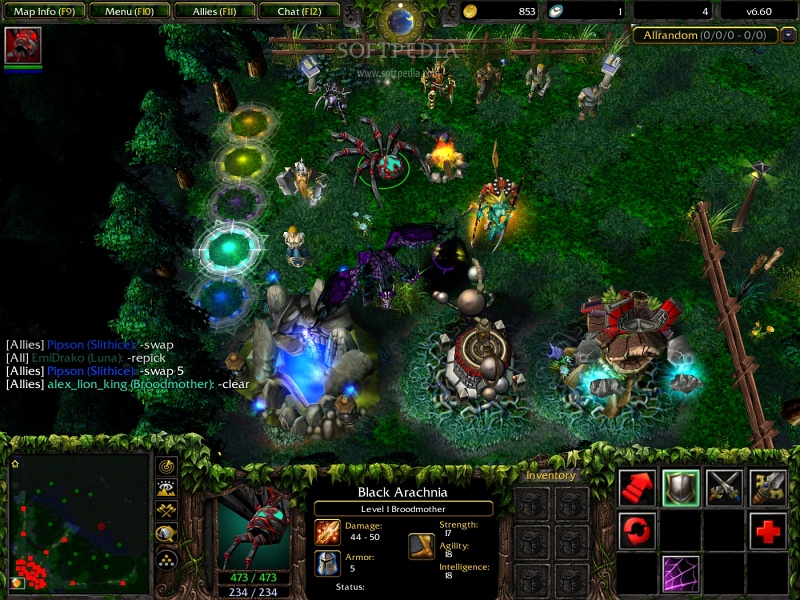 higher technology and newer interface games like Call of Duty or any Xbox or PS3 console game. DotA stands for Defense of the Ancients. It is the biggest custom scenario for the real-time strategy video game Warcraft III and it's expansion. It is argued that DotA is the most popular free, non-supported game mod in the world.
Anyway, in this game:
- players on each side choose one of 104 heroes
- each have different abilities which create advantages and disadvantages over other heroes.
- The scenario is highly team-oriented; and just like Basketball, it is difficult for one player to carry the game alone.
- It requires one to kill the spawned units called "creeps" and to "last hit" them in order to get the money, thus there is a specific strategy involving the efficient gaining money (also called farming), which leads to the buying of items.
- One gains experience and gains levels to upgrade skills/spells, and if one dies, one loses gold and the opportunity for experience.
- The items bought can be used to create other higher tier items and these are known as "recipe" items.
- As each hero has different abilities and attributes, different items tailor to different heroes and knowledge of all these things are extremely important.
- Players will eventually memorize these recipes as they play the game more.
In addition, each game takes around an average of 40 minutes and no one game is the same, each game has a ridiculous amounts of variation even if each team is constant and each player chooses the same hero. The gameplay changes, and if you throw in the fact that there are 104 heroes to choose from with multiple modes to change it up (such as all random or random draft), this makes for a highly unpredictable game. Yet, one of the things I love about it is, if one messes up, one can play again the next game and it is a brand new slate! This resonates with one of the key points in Gee's article which was risk taking where he discusses how "good video games lower the consequences of failure" and how in these games, players are encouraged to take risks, explore, and try new things and that failure is a good thing as it allows one to learn from their mistakes. Gee argues that "school too often allows much less space for risk, exploration, and failure" and this can be rectified in the classroom by creating a classroom conducive to -- (haha, you thought I was going to say conducive to failure didn't you!) -- an openness for failure and its' utilization in the learning process.
So while Gee says that his suggestion is not to "use games in school" he does state that it is indeed a good idea. Perhaps the students should play DotA, and I can definitely be certified to teach that! It would definitely spawn quite a generation of people who would be efficient, knowledgeable, and able to work on a team.
After all, it did inspire one of the catchiest songs of all time which took #2 in Finland and #6 in Norway by an artist named Basshunter singing in Swedish:

